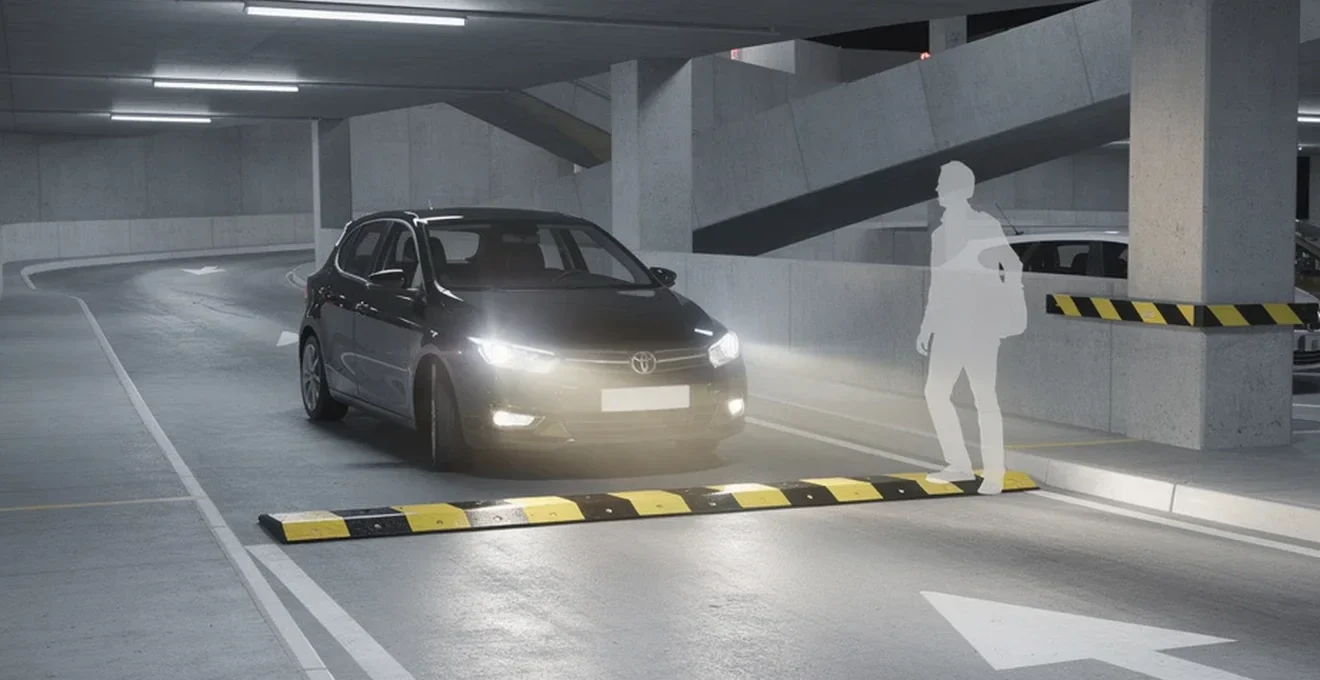
Car parks bring vehicles and pedestrians into close, constant contact, often in spaces with restricted sightlines, tight manoeuvring areas, and drivers who aren’t fully focused on their surroundings. Speed is one of the biggest variables you can control. Reduced vehicle speeds give drivers more time to react to obstructions or pedestrians, and they significantly limit the severity of any impact if a collision does occur. This is especially true in multi-storey car parks, where ramps, columns, and tight bays create additional risks that don’t exist in open surface car parks. This guide looks at where pedestrian-vehicle conflict happens, the traffic calming measures and technology available to manage speed, the regulatory requirements around signage and lighting, and the liability considerations that make speed control a priority for any car park operator.
Pedestrian-vehicle conflict zones in Multi-Storey car parks
Multi-storey car parks present a distinct set of risks compared with surface-level car parks. The combination of ramps, columns, tight turning circles, and reduced natural light means drivers and pedestrians have less time and space to spot one another. Identifying where these conflicts are most likely to happen is the first step in reducing them.
Blind corner collision risks at ramp junctions
Ramp junctions are a common site for collisions because drivers are often navigating a change in gradient and direction at the same time as watching for pedestrians and other vehicles. Blind corners compound this risk by removing the driver’s ability to see approaching traffic or pedestrians until the last moment. Warning signs alerting both pedestrians and drivers to the hazard, combined with convex mirrors to widen the field of vision, are practical ways to reduce the danger at these points.
Shared surface design flaws in retail car park layouts
Retail car parks often mix pedestrian and vehicle movement across the same surface, particularly near trolley bays, entrances, and disabled parking. Where pedestrian routes aren’t clearly separated from vehicle routes, drivers and pedestrians are forced to negotiate space on an ad hoc basis, increasing the risk of an incident. Marking out walkways with bollards or barriers, and creating zebra-style crossings with signage advising pedestrians to look both ways, helps make these shared areas safer and more predictable for everyone using them.
Reversing incidents near disabled bays and Parent-and-Child spaces
Disabled bays and parent-and-child spaces tend to see a higher volume of pedestrian activity around parked vehicles, including people with mobility difficulties and adults managing young children. Reversing manoeuvres near these bays carry particular risk because drivers may have restricted visibility of anyone standing or walking close behind their vehicle. Extra room should be allocated around these bays, and clear separation maintained between parking areas and pedestrian routes, to reduce the chance of a reversing incident.
Line-of-sight obstructions caused by structural columns
Structural columns are unavoidable in most multi-storey car parks, but they create fixed obstructions that can hide pedestrians from approaching vehicles, and vice versa. Where columns interrupt sightlines along common routes or near junctions, convex mirrors can help widen the effective field of vision, giving drivers advance warning of anyone stepping out from behind a column.
Speed bump and traffic calming specifications for car parks
Signs alone rarely achieve consistent compliance with speed limits, particularly where drivers enter from faster roads and misjudge how quickly they’re actually travelling. Physical traffic calming measures force a change in driving behaviour, giving everyone in the car park more reaction time and reducing the severity of any impact.
BS 5709 compliance for speed cushion installation
Speed cushions are a practical alternative to full-width speed bumps in car parks that need to accommodate a mix of vehicle types. They are narrow enough to allow large vehicles, such as delivery lorries, to straddle them with their wider wheelbase, while still being wide enough to slow down cars. This makes them particularly useful in car parks where regular visitor traffic and commercial deliveries share the same routes.
Optimal speed hump spacing on ramped decks
Speed bumps work best on long straight runs, outside entrances, near pedestrian crossings, and around higher-risk sites such as schools, depots, and warehouses. On ramped decks specifically, positioning needs to account for the added momentum vehicles can build on a gradient, meaning calming measures may need to be placed more frequently or closer to junctions and crossings than on flat surfaces.
Rubber versus thermoplastic speed bump durability
Line markings and symbols can be applied using either liquid paints or thermoplastics, each suited to different purposes. Liquid paints are typically used to colour larger areas, such as painting disabled bays blue or EV charging bays green, or to make pedestrian zones stand out. Thermoplastic markings are bonded to tarmac or concrete by melting them onto the surface, and are available as tape for lines or as preformed symbols for speed limits and disabled bays. Both are durable and long-lasting, but need refreshing periodically, since faded or worn markings can cause confusion and become slippery in wet weather.
Chicane and deflector barrier placement strategies
Alongside speed bumps and cushions, physical layout features such as bollards and barriers help enforce safe driving lines through a car park. Flexible bollards marking the ends of parking bays can withstand occasional light impact, while wheel stops and barriers help prevent vehicles overshooting bays and striking corners, doors, or equipment. These measures work alongside signage and markings to create a controlled, predictable route through the site, rather than relying on drivers to interpret an open space correctly.
ANPR and speed detection technology in car park management
Technology has an increasing role to play in managing vehicle behaviour within car parks, complementing physical calming measures and signage with real-time monitoring and enforcement capability.
Ultrasonic sensor integration for Real-Time speed monitoring
Sensor-based monitoring can support car park operators in tracking vehicle movement and speed across a site, feeding into wider traffic management systems. This kind of monitoring is particularly useful in larger or multi-level car parks where staff cannot observe every route or junction directly.
Vehicle speed data logging via APCOA and NCP systems
Larger car park operators may use established management systems to log vehicle activity and support enforcement of site rules, including speed compliance. This data can help identify recurring problem areas, such as junctions or ramps where speeding is common, allowing operators to target additional signage, markings, or physical calming measures where they will have the most impact.
Automatic barrier response triggered by speed violations
Automated access control systems, including barriers linked to ticketing on entry and exit, help control the flow of traffic into and out of a car park. Integrating barrier systems with wider monitoring can support a more managed approach to vehicle behaviour on site, ensuring that entry and exit points don’t become bottlenecks or points of conflict with pedestrians.
Signage and line marking requirements under UK traffic regulations
Clear, well-placed signage and markings reduce hesitation, confusion, and poor driving decisions. They are also one of the more cost-effective ways to improve car park safety, provided they are installed correctly and kept in good condition.
5mph speed limit signage placement per traffic signs regulations 2016
Speed limit signs are a key tool for setting driver expectations as soon as they enter a car park. Class 1 reflective signs are designed to reflect light from wide angles, giving a higher grade of reflectivity that keeps them visible at any time of day, and particularly useful in low light conditions or at night. 5mph and 10mph speed limit signs are commonly used in car park management, private traffic routes, construction areas, and industrial estates, and are available with wall or post fixings depending on the environment. Sign placement matters as much as the sign itself: signs need to be positioned at the right height and location so they are visible before the driver needs to act on them.
Directional arrow and Give-Way marking standards
Road markings help drivers understand a car park’s layout without needing to stop and think, preventing the kind of chaotic « free-for-all » that leads to accidents. Key markings include bay lines, directional arrows, pedestrian walkways, disabled symbols, parent and child bays, loading bays, no parking areas, hatched zones, and give-way or stop markings. Speed limit markings are particularly useful at entrances, reinforcing the message from signage at the point where drivers are most likely to be adjusting their speed.
Reflective road studs for Low-Visibility basement car parks
Basement and underground car parks present particular visibility challenges, since natural light is absent and artificial lighting must do all the work of highlighting routes, hazards, and pedestrian crossings. Reflective signage and markings become especially important in these environments, helping drivers pick out routes, junctions, and crossings clearly, regardless of the ambient lighting conditions.
Structural and lighting factors influencing safe vehicle speeds
The physical design of a car park has a direct bearing on how safely vehicles can move through it. Gradients, lighting, and ceiling heights all affect a driver’s ability to see hazards and react appropriately.
Gradient limitations on helical ramp design
Ramps connecting different levels of a multi-storey car park need to balance space efficiency against safety. Steeper or tighter ramp designs increase the risk of vehicles gaining speed unintentionally, or drivers struggling to see around the curve of a helical ramp. Traffic calming measures such as speed cushions are particularly valuable on these sections, where a driver’s control over their vehicle’s speed may be reduced.
Illuminance levels required under BS 5266 for car park lighting
Poor lighting increases the risk of accidents, security threats, and pedestrian injuries. Car parks should be well-lit throughout, with particular attention paid to pedestrian paths, stairwells, and blind spots where visibility is naturally reduced. High-quality lighting, combined with reflective bollards and convex mirrors, helps both drivers and pedestrians identify hazards and each other in good time, which is especially important in enclosed or underground car parks with no natural light.
Ceiling height restrictions affecting visibility on upper decks
Height restrictions in multi-storey car parks are usually there to prevent larger vehicles from entering areas they cannot safely manoeuvre through. Height restrictors act as a highly visible deterrent and a physical barrier, reducing the number of vehicle incidents that would otherwise occur if oversized vehicles attempted to use the space. Beyond restricting vehicle size, lower ceiling heights on upper decks can also affect the mounting position and spread of lighting, making it important to plan illumination carefully to avoid dark patches near columns or low beams.
Insurance liability and health and safety executive guidelines on car park speed incidents
Car park safety isn’t just a matter of good practice: it sits within a wider framework of legal duty and liability. Employers and site operators have specific obligations to manage the risks vehicles pose to pedestrians on their premises.
RIDDOR reporting obligations for Vehicle-Related injuries
Where a vehicle-related incident on site results in injury, employers and site operators need to be aware of their reporting obligations. Keeping accurate records of the layout, signage, and control measures in place at the time of an incident, along with maintenance checks, supports compliance and provides a clear picture of what safety measures were operating on site.
Employer duty of care under the health and safety at work act 1974
Employers have a duty to assess the risks vehicles pose on their site and put in place appropriate controls. This starts with understanding how many vehicles use the site, where they go, what the drivers do, what types of vehicles are involved, how parking needs to be controlled, how pedestrians will be segregated from traffic, how the need for manoeuvring and reversing can be minimised, and how safe parking will be enforced. Wherever possible, parking areas should be provided for all vehicles using the workplace, including work-related vehicles, private cars, motorcycles, and pedal cycles, and these areas should be safe, suitable, clearly signposted, firm, level, well drained, not slippery, and well lit. Controlled parking areas are particularly important wherever uncontrolled parking might narrow routes, block sight lines, or force pedestrians onto vehicle routes. When drivers enter a controlled parking area, they need to be told clearly that they may only park in allowed places, and how to recognise those areas; where parking is controlled across an entire site, this information should be given at the site entrance.
Manoeuvring is a significant contributor to workplace vehicle incidents, so parking areas should be designed so that only simple manoeuvres are needed to park and leave, avoiding the need for reversing wherever possible. Drive-through parking arrangements are the safest option; where this isn’t possible, arranging bays at an angle backwards to the flow of traffic encourages reverse parking, which reduces the number of vehicles reversing out into moving traffic and improves visibility for departing drivers. Where vehicles must be parked on a slope, they should face up or down the slope rather than sideways, have their brakes applied, be left in gear where safe to do so, and use wheel chocks when necessary. Drivers must never leave a vehicle without ensuring it and any trailer are securely braked.
Third-party liability claims following Low-Speed collisions
Even at low speeds, vehicle impacts can cause injury to pedestrians or damage to buildings, equipment, and other vehicles, and repeated low-speed impacts can add up to significant repair costs over time. Physical protection such as wheel stops, bollards, and barriers helps prevent vehicles from overshooting bays and striking vulnerable points like corners, doors, payment machines, lighting columns, and EV chargers. Bollards should be considered at building entrances, shopfronts, roller shutters, pedestrian walkways, plant rooms, EV charging points, trolley bays, and bin stores. Where enforcement of parking restrictions is a persistent problem, a wheel-clamping scheme or other measures may be appropriate, and a full survey of parking demand and availability, potentially involving professional engineers, can help identify where liability risks are highest and where additional controls are needed.